
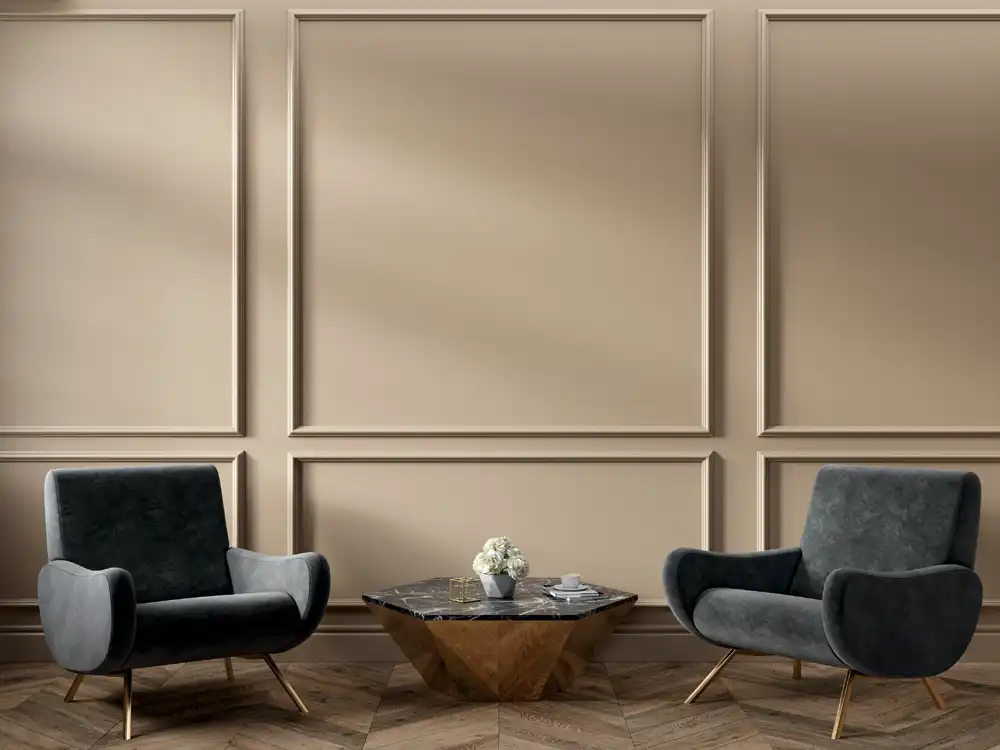
Compare wainscot, wall panelling and wall moulding so you can choose the right decorative wall treatment for your design, budget and installation plan.
Why these terms are often confused
Wainscot, wall panelling and wall moulding are related but not identical. Interior-design conversations often use them interchangeably because all three can add depth and pattern to a plain wall. Understanding the distinction helps you specify the right material and explain the intended result to designers, contractors and suppliers.
What is wainscot?
Wainscot describes a decorative treatment traditionally applied to the lower portion of a wall. It may include panels, rails, frames and skirting details. Today, the term is also used for paintable picture-frame compositions that imitate panel proportions without installing a continuous solid panel across the wall.
The defining feature is the organised architectural layout, often below a horizontal rail. Modern interiors may extend the same language to full height.
What is wall panelling?
Wall panelling generally means the wall is covered or partly covered by boards, sheets, slats, padded modules or other panel products. The panel itself forms a visible surface. Depending on the system, it may introduce colour, texture, pattern, acoustic softness or dimensional relief.
Because wall panels cover more area, their material and edge details have a strong influence on the final appearance. Installation often requires careful consideration of joints, corners and service access.
What is wall moulding?
Wall moulding is a profile installed on a wall to create borders, frames, rails or decorative lines. It does not necessarily cover the area inside the frame. When the moulding and wall are painted together, the plain wall becomes the visual infill.
Mark Decor's Wall Mouldings include a Paintable collection suited to framed layouts and wainscot-inspired compositions.
Key differences at a glance
| Aspect | Wainscot | Wall Panelling | Wall Moulding |
|---|---|---|---|
| Meaning | Completed decorative wall composition, usually lower-wall | Boards or modules covering wall area | Profiles forming borders, rails or frames |
| Coverage | Partial or full wall | Partial or full wall | Linear elements only |
| Finish | Often painted | May be prefinished or site-finished | Often painted when used for wainscot |
| Design control | Controlled by panel proportion and rail height | Controlled by panel size, texture and joints | Controlled by profile and frame layout |
Which option should you choose?
Choose a wainscot composition when you want classic proportions, paint flexibility and a structured lower wall. Choose wall panelling when the surface material itself should provide colour, texture or coverage. Choose individual wall mouldings when you want to design custom frames, borders or a full-wall grid.
Many projects combine the ideas. A wall can use moulding profiles to create a wainscot layout, while another feature wall uses decorative panels. The selection should follow the room concept rather than force one treatment everywhere.
Project questions to answer
- Do you want the wall colour to remain visible inside the frames?
- Should the treatment cover only the lower wall or reach the ceiling?
- Will the finish be painted on site or supplied prefinished?
- How will corners, doors, skirting and switches be handled?
- Is the wall dry, level and ready for installation?
- Does the design need future repainting flexibility?
Frequently asked questions
Can wall moulding create wainscot without solid panels?
Yes. Picture-frame mouldings can create panel outlines while the existing wall forms the centre area.
Is all wall panelling wainscot?
No. Full-height slat walls, soft panels and decorative sheets are wall panelling, but they are not necessarily wainscot.
Which is more modern?
Any of the three can look modern. Proportion, profile simplicity, colour and surrounding furniture determine the style.
Compare design options through Mark Decor Wall Mouldings, visit the Paintable collection, and browse more guidance in Mark Decor Blogs.


