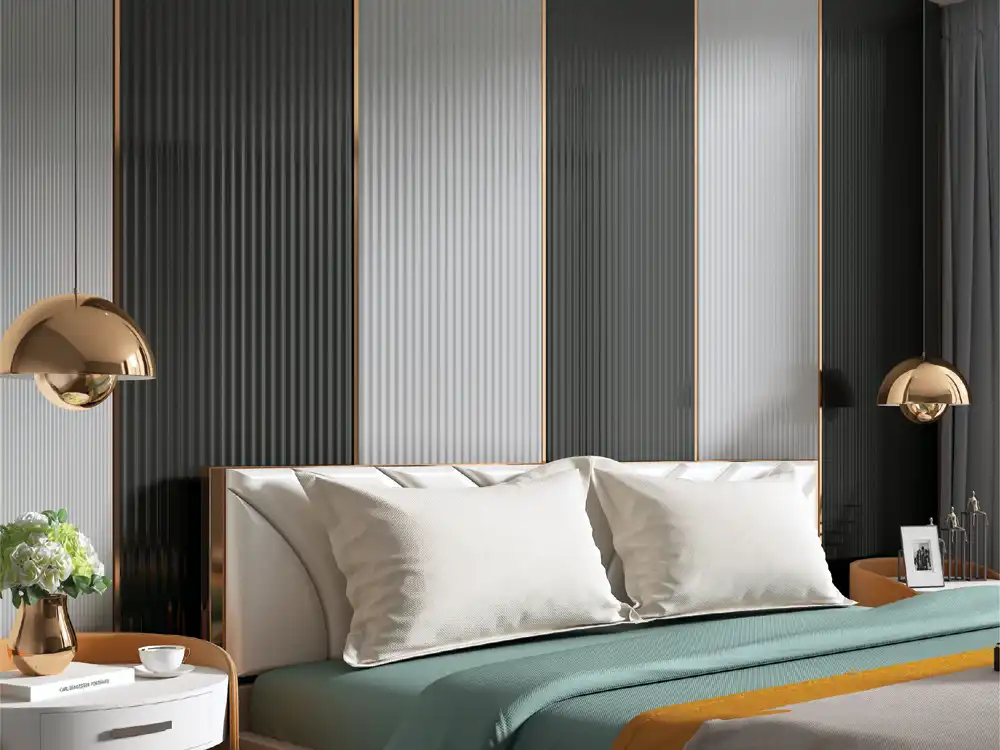

Small-living-room rescue scenarios showing how louver scale, colour, coverage and placement can add depth without making compact spaces feel crowded.
A small living room does not need less design; it needs more editing. A single well-placed louver feature can add vertical rhythm and depth, while the wrong coverage can make every wall compete for attention. The question behind louver design for small living room spaces is therefore not “Can I use louvers?” but “Where will they earn the limited visual space?”
The scenarios below start with common compact-room problems and show how the design can be rescued. Use the Mark Decor Louvers category and a suitable Volume - 6 collection while testing colour and profile rhythm.
Rescue 1: the TV wall feels flat, but full coverage feels too heavy
Before: a compact wall holds a television and low console. Covering the entire surface with dark louvers would make the screen zone dense.
After: use a narrower vertical louver band beside the screen or behind one portion of the console. Keep the immediate TV background calmer. The texture gives the wall identity without surrounding the screen with constant lines.
The band can align with a cabinet edge or open shelf so it looks integrated rather than decorative for its own sake.
Rescue 2: the room has low ceiling height
Before: a broad horizontal feature visually reinforces the low proportion.
After: choose a vertical louver orientation and run it cleanly upward within a controlled zone. Vertical repetition can draw attention toward height, especially when the top termination is simple.
Keep the finish light or medium in a dim room. A very dark full-height feature can still feel heavy even though the lines are vertical.
Rescue 3: the sofa wall already has artwork and lighting
Before: the plan adds louvers behind the entire sofa, two wall lights, three artworks and a shelf.
After: choose one hero. If artwork matters, use louvers only as a narrow side band or framed vertical strip. If the louver texture is the hero, reduce the number of wall objects.
Small rooms benefit from hierarchy because every additional object occupies a larger percentage of the visual field.
Rescue 4: the living room opens directly from the entrance
Before: there is no foyer, so the first view into the home feels undefined.
After: use a louver feature on the first wall or a carefully planned partial divider where the selected system is appropriate. The same finish can reappear subtly near the TV console to connect entrance and living room.
Do not repeat the full feature twice. A small echo is enough to create continuity.
Rescue 5: the room feels visually narrow
Before: strong dark finishes on both long side walls make the space feel compressed.
After: concentrate texture on one focal wall and keep adjacent walls lighter and quieter. If using vertical louvers, select a tone that sits close to the wall colour rather than creating extreme contrast.
Visual width is influenced by the whole palette, not by louver direction alone.
Rescue 6: the homeowner likes dark walnut but the room lacks daylight
Before: the plan covers the dominant wall in a very dark finish because the small sample looked premium.
After: use the dark finish on a smaller bay and pair it with warm off-white walls, lighter furniture or a mirror placed where it reflects useful light. A dark material becomes an accent instead of a large visual mass.
View the actual sample under the room’s evening lighting before finalising.
Rescue 7: the wall has a door too close to the feature
Before: louvers run into the door frame and leave an awkward narrow strip.
After: stop the feature earlier and treat the remaining plain wall as an intentional border. Align the louver edge with the console or a ceiling light rather than forcing full-width coverage.
In compact spaces, clean edges make the design feel more expensive than maximum coverage.
Rescue 8: the room needs storage as well as decoration
Before: a full louver wall consumes the only area available for useful cabinets.
After: integrate a low console, side storage or floating cabinet with a louver backdrop in one section. Let storage solve the practical problem and texture solve the focal problem.
A small living room should not sacrifice everyday function for a wall feature.
Rescue 9: the profile looks too busy at close range
Before: a very fine repeated pattern is selected from a distant inspiration image.
After: stand at the actual sofa-to-wall distance with a larger sample or display. In a small room, viewers are close to the wall, so narrow repetitive lines can feel more active.
Compare alternatives in the Volume - 6 collection and choose a rhythm that remains calm from normal seating distance.
Rescue 10: lighting creates harsh stripes
Before: strong spotlights directly above the grooves produce high-contrast shadow lines.
After: soften the angle, reduce intensity or use more general ambient light. Louvers already create shadow; they do not always need theatrical lighting.
Test the wall at night, because that is when a living room is often used most.
Rescue 11: too many wood tones compete
Before: the room has wooden flooring, a wood TV console, wood coffee table and a louver finish with a different undertone.
After: either choose a louver tone that relates closely to one existing wood family or move to a neutral/darker contrasting finish. Three almost-matching woods can clash more than one deliberate contrast.
Rescue 12: every wall has become a feature wall
Before: louvers on the TV wall, wallpaper behind the sofa, fluted panels at the entrance and a dramatic ceiling.
After: remove one or two treatments. Let the louver wall be the main textured surface and use paint elsewhere. Small spaces become more premium when the eye knows where to rest.
A compact-room proportion rule
Think in percentages rather than absolute size. Ask how much of the main visible wall will carry texture, how much remains plain and how much is blocked by furniture. If the decorative field dominates every visible surface, reduce it.
There is no universal ideal percentage, but the exercise forces you to design the negative space as carefully as the louvers.
One more small-room check: view the wall from the entrance
The first view into a compact living room often determines whether the feature feels balanced. Stand at the doorway and check whether the louver zone supports the main furniture composition or becomes the first object that overwhelms the room. This entrance view can reveal proportion problems that are less obvious from the sofa.
FAQs
Are louvers suitable for very small living rooms?
Yes, when the coverage, colour and profile rhythm are controlled. A narrow feature or partial wall can be more effective than full coverage.
Which louver colour makes a small room look bigger?
No colour guarantees a larger appearance, but lighter or lower-contrast finishes generally create less visual weight than very dark, high-contrast features.
Should a small TV wall use vertical or horizontal louvers?
Both can work. Vertical rhythm may emphasise height; horizontal rhythm can emphasise width. Choose according to the room proportions and screen composition.
Can louvers be combined with a mirror in a small living room?
Yes, if the mirror is properly supported and the composition remains simple. Use the mirror as one major element rather than adding several competing details.
Small rooms reward editing more than decoration
Successful louver design for small living room interiors comes from subtraction. Give the louvers one clear role, control the colour weight, resolve edges neatly and leave enough plain surface for the room to breathe.
Explore Mark Decor’s Louvers range and a suitable Volume - 6 collection. For a compact-space concept, contact Mark Decor with the wall dimensions and room photograph.