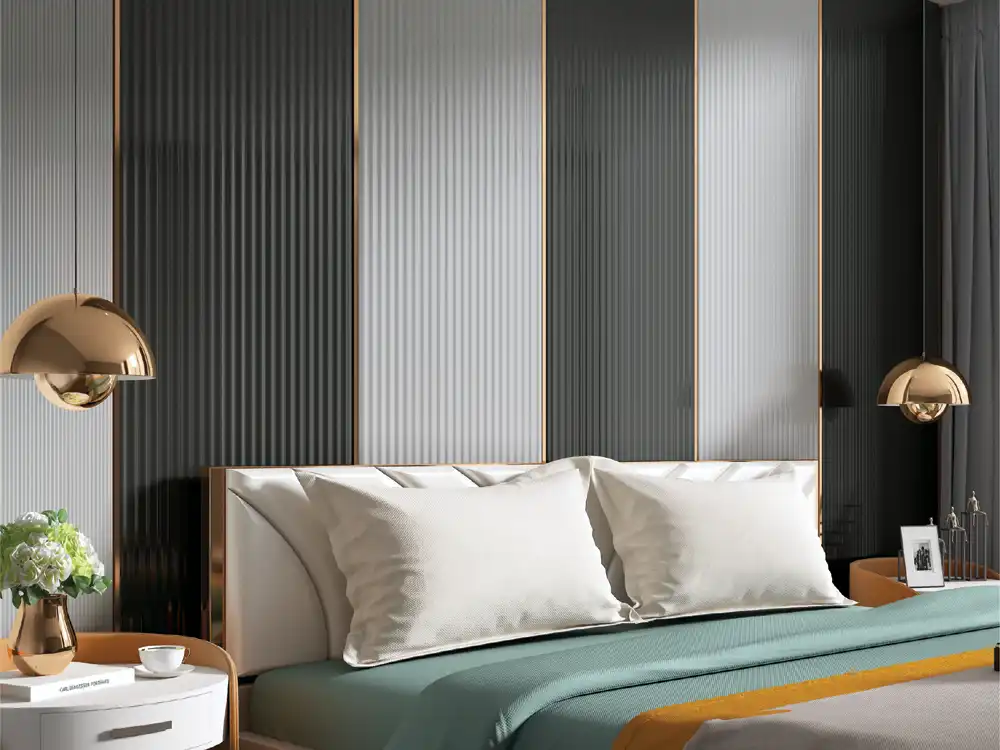

Three practical home-entrance louver layouts for compact foyers, console walls and open-plan entries, with proportion, mirror, lighting and storage guidance.
The entrance to a home has very little time to establish order. Shoes, keys, bags, a console, mirror, door swing and passage into the living area may all compete within a few square metres. Good louver design for home entrance works because vertical rhythm can organise this visual activity without requiring a bulky feature.
This guide offers three entrance plans rather than a long list of unrelated ideas. Choose the plan closest to your layout, then adapt it using the Mark Decor Louvers category and a relevant Volume - 6 collection.
Plan A: The compact apartment foyer
This layout suits an entrance where the front door opens close to the living room and there is only one short wall available. Use louvers on a controlled vertical band rather than covering the entire wall. Add a floating console or slim shoe cabinet below, with one mirror or artwork element above.
The louver band can sit behind one side of the console, creating an asymmetrical composition that feels wider than a fully boxed feature. Keep the remaining wall in a simple paint colour. This gives the eye a resting area and prevents the entrance from feeling narrow.
Proportion rule
Let the louver band be wide enough to look intentional but clearly smaller than the full wall. Align its edge with the console, mirror or ceiling light so it belongs to the same composition.
Lighting rule
Use a focused ceiling light or soft side illumination. Too many concealed strips can make a small foyer look like a display booth.
Plan B: The console feature wall
If the entrance has a dedicated wall opposite or beside the main door, make the console the anchor. Louvers can form the background, but do not allow the console, mirror, wall light and decorative objects to compete equally.
One balanced formula is a broad louver field, a simple console, and a mirror placed partly over the textured area. Another is a framed louver section with the mirror centred within it. Choose the option that suits the wall width and door position.
Proportion rule
The console should usually occupy less than the full louver width so the vertical texture remains visible at the sides. A mirror can overlap the field, but its shape should contrast intentionally with the vertical lines—for example, a round or softly curved mirror can balance a rigid rhythm.
Storage rule
If the console doubles as shoe storage, maintain practical opening clearance and avoid projecting handles into the walking path.
Plan C: The open-plan entrance transition
Some homes have no enclosed foyer. The entrance opens directly into living or dining space. Here, louvers can create a visual transition without constructing a heavy partition. Use them on the first wall, around a shallow niche or as a partial-height architectural screen only where the system is designed for that application.
Repeat a related finish later in the living room—perhaps on the TV wall or a small panel—so the entrance feels connected to the main interior rather than like a separate decorative theme.
Proportion rule
Keep the first feature strong enough to mark arrival but not so large that it dominates the entire open plan. The living room should still have its own focal point.
Colour rule
Choose a finish that bridges the door, floor and living-room palette. An exact match is less important than compatible undertones.
Use louvers to solve awkward wall edges
Entrance walls often include electrical panels, door frames, intercoms or switches. Instead of forcing the louver field across every interruption, terminate it cleanly before the service zone or incorporate a planned access detail.
Essential controls must remain visible and serviceable. Decorative continuity should not make future maintenance difficult.
Frame the door only when the architecture supports it
A louver return beside the main door can create a premium portal effect, but it needs enough wall width. In a very tight foyer, adding texture directly beside a wide door frame can make the entrance visually crowded.
Draw the door open and closed on plan. Check that no projecting detail conflicts with handles, locks or the swing path.
Choose one hero object
The entrance may include a mirror, artwork, sculpture, pendant or console styling. Pick one as the hero. Louvers then become the architectural background. If every object is large and decorative, the entry can feel more like a showroom than a home.
Review the Volume - 6 collection with this hierarchy in mind. A stronger louver finish needs quieter accessories; a calmer finish can support a more expressive artwork.
Coordinate skirting and flooring transitions
The bottom edge of the louver field meets skirting, console furniture and floor. Decide whether the skirting continues across, stops at the feature or is integrated into another detail. Small inconsistencies at floor level are very noticeable near an entrance because visitors stand close to the wall.
Use vertical rhythm to adjust perceived height
Vertical louvers naturally draw the eye upward. This can help a compact foyer feel taller, especially when the field runs cleanly toward the ceiling. However, very dark full-height texture can still feel heavy in a narrow entry. Balance colour, width and lighting.
Do not hide practical life
A beautiful entrance must still handle keys, shoes, delivery packages and daily bags. Provide drawers, baskets or closed shoe storage. Keep the decorative wall free from random hooks unless they are part of the original design.
The best foyer remains presentable because everyday objects have somewhere to go.
Lighting: three useful approaches
Downlight: a focused ceiling light can reveal texture without adding visible fixtures to the wall. Wall light: a decorative sconce can create a residential, welcoming mood when positioned beside rather than directly over a busy pattern. Concealed light: use sparingly at a frame edge or niche where the detail is properly built.
Always test the light angle. Louvers can produce strong shadow, and the most dramatic effect is not always the most comfortable for a home entrance.
A quick foyer measurement checklist
Record wall width and height, door swing, console width, skirting height, switch locations, mirror dimensions and the distance from the wall to the main walking path. Photograph the wall straight-on. These basic measurements make sample and quantity discussions far more useful.
FAQs
Are louvers suitable for a small home entrance?
Yes, especially when used on a controlled band or framed feature rather than automatically covering every wall. Keep furniture slim and leave some plain wall for visual breathing space.
Should the foyer louver match the TV-wall louver?
It can repeat the same finish for continuity, but it does not have to be identical. A related tone or profile can connect the spaces while allowing each focal wall to have its own composition.
Can a mirror be installed over a louver wall?
Yes, when the mirror support and fixing method are properly planned. The substrate should carry the required load; decorative louvers should not be assumed to provide structural support.
Which lighting works best with foyer louvers?
Downlights, wall lights or restrained concealed lighting can all work. Choose the approach that reveals texture without creating glare or excessive shadow.
Make the entrance practical first, memorable second
Successful louver design for home entrance starts with movement and storage, then adds visual rhythm. Whether you choose a compact band, full console wall or open-plan transition, keep the proportions controlled, give one object priority and plan the lighting around real daily use.
Explore the Mark Decor Louvers range and the relevant Volume - 6 collection, then contact Mark Decor with your foyer wall dimensions, console size and preferred finish direction.