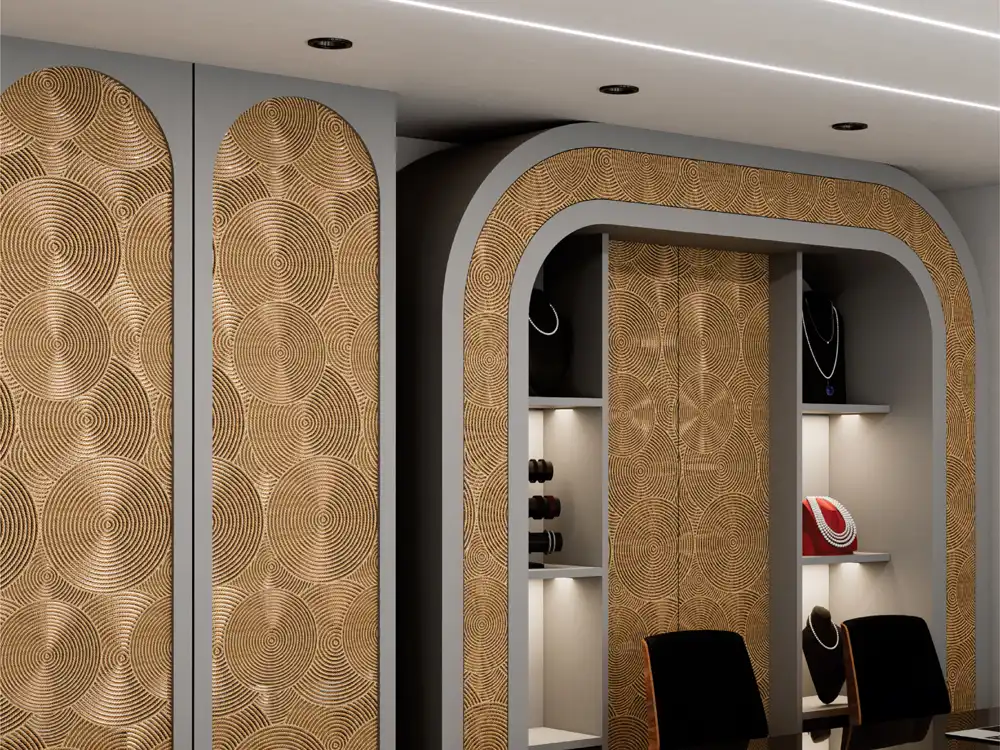

Practical guide to wall panel manufacturer in India covering quality, selection, samples, documentation, supply and project buying considerations.
wall panel manufacturer in India is a search that usually comes from a buyer already comparing products, manufacturers or project options. This guide uses practical selection criteria instead of unsupported rankings or generic marketing claims.
Explore relevant Mark Decor product routes such as Graffito Soft Panels, Liquid Metal Panels and Mirror Art. Use current product pages and physical samples as the final reference for collection availability, dimensions and finishes.
Define the panel category
Wall panels can mean flexible textured surfaces, metallic decorative panels, mirror systems, mouldings or linear profiles. Start by defining the actual product family.
Test the decision against the real wall, room scale and adjoining materials rather than an isolated product photograph. Furniture, flooring, paint, stone, lighting and ceiling height can all change how the surface is perceived.
Match capability to application
A curved column, bedroom wall and retail reception need different panel behaviour and detailing.
Test the decision against the real wall, room scale and adjoining materials rather than an isolated product photograph. Furniture, flooring, paint, stone, lighting and ceiling height can all change how the surface is perceived.
Surface and edge quality
Look for consistent texture, clean edges and stable faces because joints and shadows reveal defects.
Compare more than one piece under the lighting in which the material will actually be seen. A showroom sample viewed flat on a table can look different once repeated vertically across a complete wall.
Collection documentation
Dimensions, product codes and application information make estimating and specification easier.
Clear documentation reduces site interpretation. The same collection name and product code should appear on the approved sample, quotation and purchase communication whenever possible.
Evaluate at wall scale
Several panels together reveal repetition, colour continuity and joint quality better than a single sample.
Test the decision against the real wall, room scale and adjoining materials rather than an isolated product photograph. Furniture, flooring, paint, stone, lighting and ceiling height can all change how the surface is perceived.
Project quantity and packing
Commercial work requires quantity control, protective packing and replacement procedures.
For larger orders, keep the approved product code, quantity calculation, delivery notes and photographs together. This helps dealers, designers, contractors and the site team stay aligned when work is delivered in phases.
Communication and repeat supply
The supplier should be able to identify approved collections and support repeat orders by code.
For larger orders, keep the approved product code, quantity calculation, delivery notes and photographs together. This helps dealers, designers, contractors and the site team stay aligned when work is delivered in phases.
Keep claims product-specific
Do not assume every wall-panel collection has the same flexibility, resistance or maintenance requirements.
Test the decision against the real wall, room scale and adjoining materials rather than an isolated product photograph. Furniture, flooring, paint, stone, lighting and ceiling height can all change how the surface is perceived.
How Mark Decor fits into the selection process
For current products, move from this guide to Graffito Soft Panels, Liquid Metal Panels and Mirror Art. Related Mark Decor guides can help buyers understand the category before requesting samples or quotations.
Related reading: Wall Mouldings and Wall Panels for Modern Interiors.
Before you place an order
- Confirm the exact collection and product code.
- Review a current physical sample.
- Measure the actual wall or application area.
- Plan corners, edges, cut-outs and transitions before installation.
- Calculate quantity with a realistic cutting allowance.
- Confirm availability, packing and delivery details.
- Use only product-specific verified performance claims.
Create a wall-panel brief before asking for products
Write a one-page project brief that describes the wall size, interior location, desired visual effect, lighting condition, and whether the surface is flat, curved, segmented, or interrupted by furniture and electrical points. This helps manufacturers recommend the relevant panel family instead of sending an entire catalogue. A reception wall that needs metallic depth is a different problem from a curved column that needs flexibility. Defining the problem first makes the manufacturer comparison much more useful and reduces the chance of selecting a product only because the photograph looks attractive.
Compare panel systems at installed scale
Wall panels are repeated materials, so the installed result is more important than a single piece. Ask to see several panels placed together or review an installed reference with similar wall dimensions. Look at pattern repetition, joint rhythm, texture scale, and whether the design becomes too busy across a broad area. Large commercial walls magnify both strengths and inconsistencies. A design that works on a small sample can feel very different when it covers several metres, which is why scale should be part of the quality review.
Ask how edges and transitions are intended to work
The central area of a wall is usually easy; edges are where design quality is tested. Ask how the selected panel should terminate at a ceiling, skirting, door frame, corner, mirror, stone surface, or cabinet. Some transitions may need a trim, shadow gap, return, or carefully cut edge. These details should be decided before ordering because they can affect quantity and installation. A manufacturer or supplier that provides clear product information makes it easier for the architect and installer to design those transitions properly.
Check supply continuity for multi-phase projects
Hotels, retail chains, offices, and larger residences are often completed in phases. If the same panel is likely to be required later, record the collection and product code carefully and discuss repeat availability. No supplier can guarantee indefinite availability, but clear identification makes later communication more reliable. For a phased project, keep one labelled sample and note the delivery date. If later material is required, compare it with the original reference before installation rather than assuming visual continuity without checking.
Review packaging as part of product quality
Decorative panels can leave the factory in good condition and still arrive damaged if faces and edges are not protected. For large quantities, ask how panels are bundled, separated, wrapped, and labelled. Also plan how they will be unloaded and stored on site. Material should not be left in active work zones where other trades can scratch or impact it. Packaging and handling are not glamorous topics, but they directly influence the appearance of the finished wall and the amount of replacement material required.
Judge the manufacturer by the exact panel family
A company may manufacture several decorative surface categories. Evaluate its strength in the particular family you are considering rather than applying one conclusion to every product it sells. Flexible panels, metallic panels, mirror-based designs, mouldings, and linear wall systems solve different design problems. The strongest purchase decision combines manufacturer reliability with collection-specific suitability. This is also why internal product pages and current samples should remain the final reference after an educational article helps narrow the choices.
Frequently Asked Questions
What should I ask before ordering?
Ask about codes, dimensions, samples, application limits, quantity, lead time and packing.
Do all wall panels suit curved walls?
No. Flexibility depends on the exact product and pattern.
Why inspect several panels?
Large walls expose differences that one sample may hide.
Conclusion
Choosing around wall panel manufacturer in India is easier when the comparison is based on product identity, consistency, samples, documentation and supply support. A strong manufacturer or brand relationship should reduce uncertainty from selection through delivery.