Understand Thermolam laminates, how 90° bendable surfaces support cleaner furniture edges, where they can be used, and what to check before installation.
Modern furniture is becoming visually lighter, cleaner and more continuous. Designers want shutters, drawers, counters and feature elements to look refined from the front as well as from the side. That demand has increased interest in Thermolam laminates: decorative surface sheets developed for applications where a conventional flat laminate and a separately finished edge may not deliver the desired result. Thermolam is commonly discussed as a bendable surface solution for furniture, especially when a smooth 90-degree transition around an edge is part of the design.
For homeowners, architects, interior designers and fabricators, the important point is not simply that the sheet can bend. The real value is the ability to plan a more unified surface language. When the same décor continues from the face towards the edge, the finished furniture can appear more seamless and intentional. This guide explains the concept, applications, selection process and practical questions to discuss before specifying AASA Thermolam by Mark Decor for an interior project.
What is a Thermolam laminate?
A Thermolam laminate is a decorative surfacing material intended for furniture and interior applications that require greater forming flexibility than an ordinary rigid laminate. In typical use, the sheet is applied over a prepared substrate such as MDF or another suitable board. The furniture edge is machined and prepared according to the recommended fabrication method, allowing the décor sheet to continue around the corner rather than ending abruptly on the face.
The term is often used alongside phrases such as thermo laminate, 90-degree bendable laminate, flexible laminate sheet and seamless-edge laminate. These phrases describe the design intent, but they should not be treated as universal technical specifications. Exact thickness, sheet size, minimum bending radius, adhesive, groove profile and pressing process can vary by collection. A fabricator should therefore work from the current product catalogue and installation guidance rather than relying on a generic online video.
Why are Thermolam laminates receiving attention?
The popularity of Thermolam is connected to a broader movement towards minimal detailing. Contemporary kitchens use slab shutters and restrained handles. Wardrobes are designed as full-height planes. TV units, reception desks and retail counters often combine straight faces with softened corners. In all these situations, a dark edge line, a mismatched edge band or a visible joint can interrupt the visual flow.
A bendable laminate gives the designer another way to resolve that junction. Instead of treating the face and edge as two independent finishes, the surface can be designed as one continuous element. This does not mean every joint disappears or every piece of furniture becomes curved. It means the most visible edge can be handled with greater continuity, provided the substrate preparation and application are correct.
Key design benefits
- Cleaner edge appearance: the décor can continue around selected edges, reducing the visual break between the face and side.
- Consistent colour and texture: the same selected surface remains visible across the transition, which can be useful with solid colours and subtle textures.
- More freedom for rounded details: designers can explore softened corners, profiles and controlled curves that are difficult to finish with a rigid sheet.
- Suitable for modern furniture language: the result can complement handleless kitchens, flush wardrobes, compact workstations and contemporary display units.
- Potentially simpler finish coordination: fewer separately selected edge materials may be required on the featured edge, although the complete construction should still be planned by the fabricator.
Where can Thermolam laminates be used?
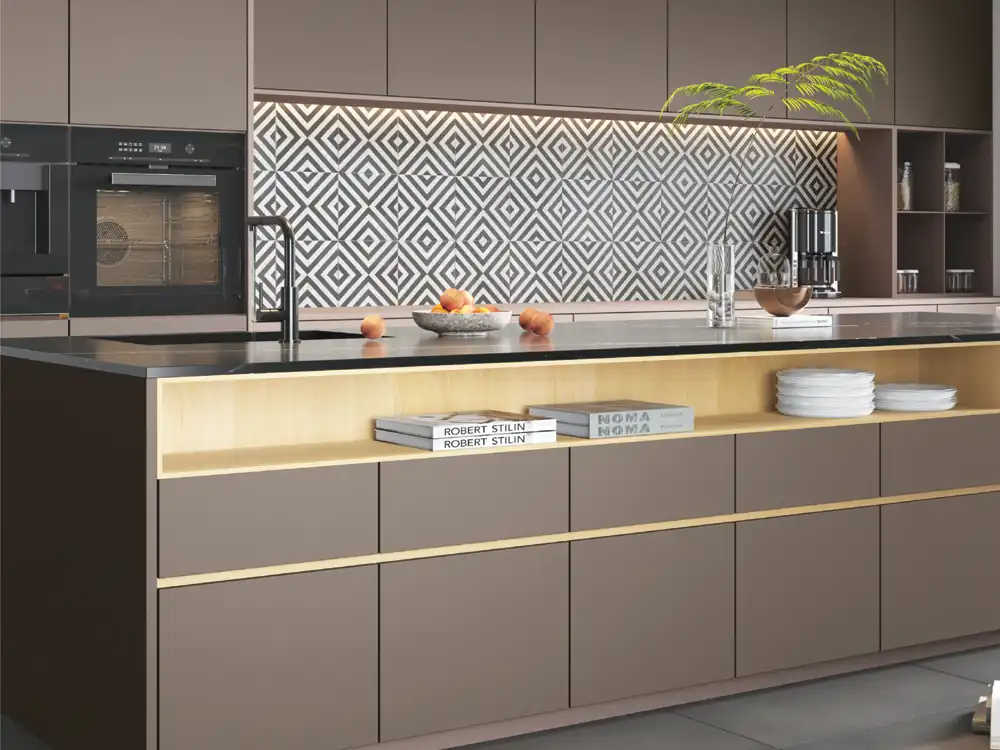
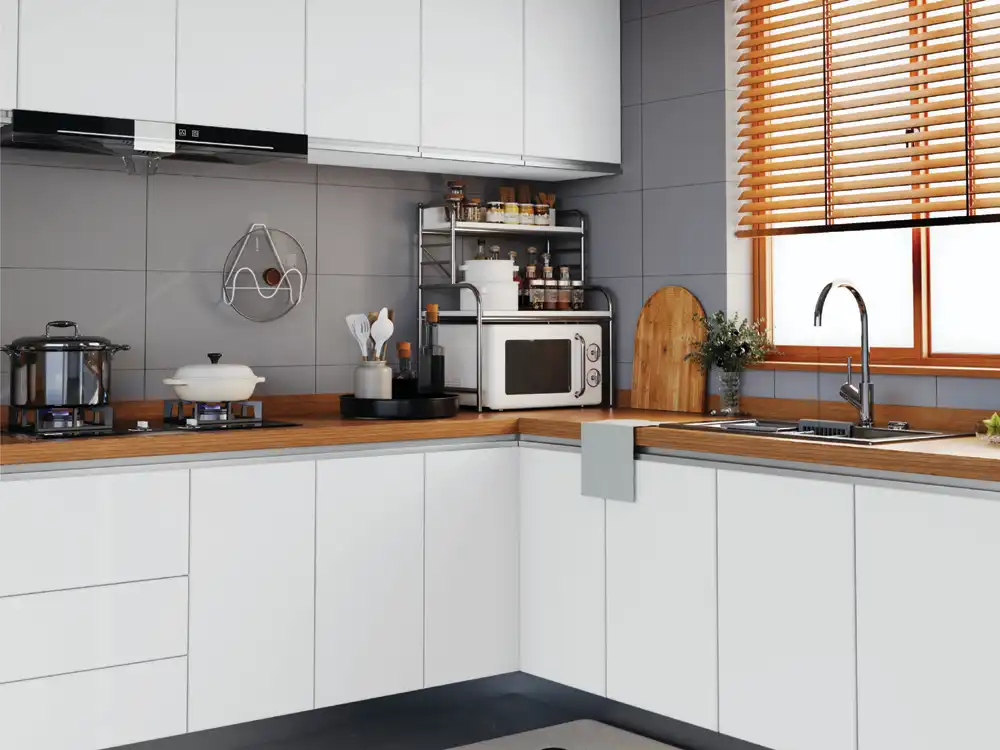
Modular kitchens are one of the most searched applications. Thermolam may be considered for cabinet shutters, drawer fronts, tall-unit shutters, breakfast counters and selected end panels where a smooth edge is desirable. The material choice must still account for sink zones, hob clearances, ventilation and the substrate used.
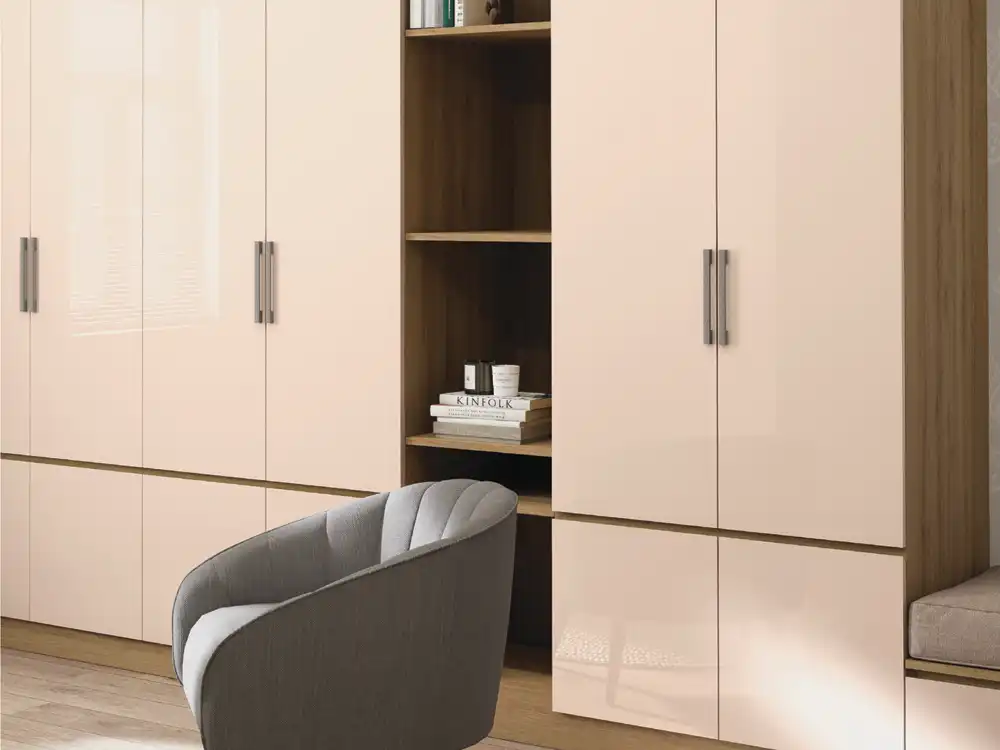
Wardrobes are another strong application because large shutters make edge quality highly visible. A continuous finish can help create a calmer elevation, particularly in solid, neutral or soft-matt colour schemes. Dressing units, bedside units and study furniture can use the same surface family for a coordinated bedroom interior.
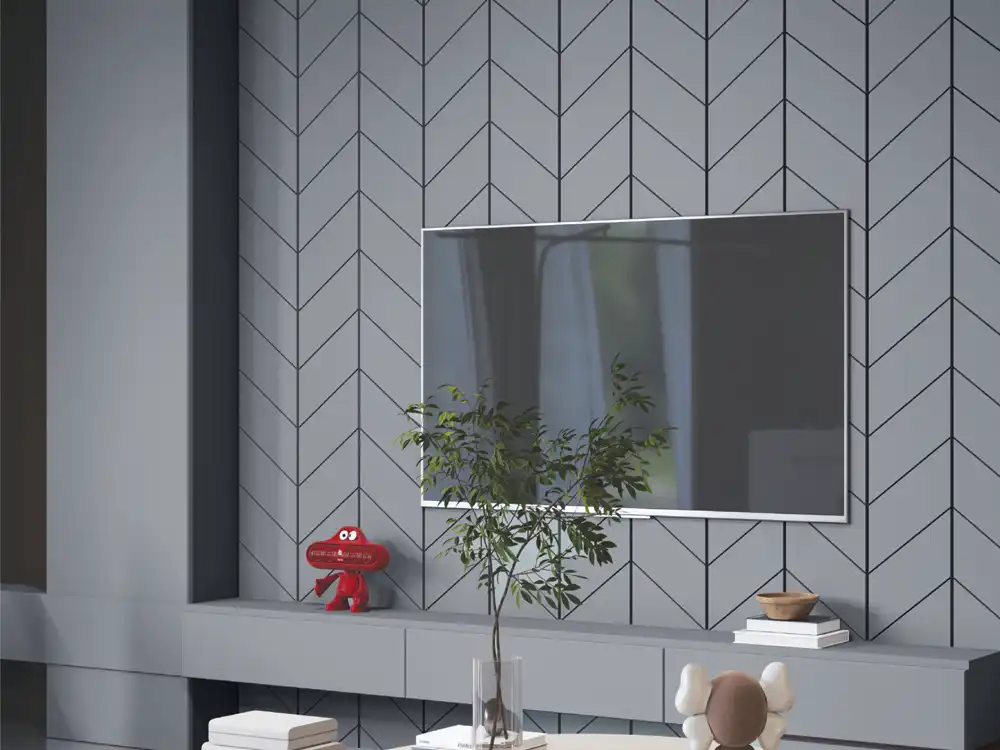
Other possibilities include TV units, office storage, reception counters, retail displays, vanity units, partitions, decorative columns, table components and custom furniture. The right application depends on geometry. A product suitable for wrapping a prepared furniture edge should not automatically be assumed suitable for every free-form curve or exterior condition.
Thermolam versus a conventional laminate-and-edge-band detail
Conventional decorative laminates remain an excellent solution for flat surfaces and are available in an enormous range of decors. A standard construction may use one laminate on the face and a matching or contrasting edge band on the exposed edge. This approach is familiar, efficient and appropriate for many budgets and designs.
Thermolam becomes relevant when the edge itself is a design priority. The purpose is not to declare one material universally better. It is to choose the construction that expresses the intended detail. A conventional edge band can be deliberately visible and attractive. A bendable laminate can be selected when the desired effect is a flowing, same-surface transition. Cost, machinery, labour skill, production repeatability and repair strategy should all be considered.
What determines the final quality?
The sheet is only one part of the finished result. The substrate should be flat, stable and correctly machined. The corner or groove geometry must follow the recommended process. Adhesive compatibility, open time, pressure and curing matter. The direction of application and the way tension is controlled around the edge can affect alignment. Dust, moisture, damaged board edges and rushed trimming can reduce finish quality even when the chosen laminate is suitable.
For this reason, ask the fabricator to create a sample corner using the actual décor, board and adhesive proposed for the project. A small mock-up provides more useful information than judging only from a loose sample. It shows colour continuity, edge radius, touch, joint placement and how the finished surface responds to normal handling.
How to choose a Thermolam design
Start with the interior concept rather than selecting a décor in isolation. Warm woods and earthy solids can create a comfortable residential feel. Pale neutrals can make compact kitchens and wardrobes appear lighter. Deep tones can look sophisticated on a feature island, TV console or reception desk, but lighting and fingerprints should be evaluated. Textured designs add tactile depth, while quiet solid colours emphasise form and edge continuity.
View the full sheet or a sufficiently large sample. Small swatches may not reveal pattern repeat, grain direction or the way a colour changes under warm and cool lighting. Compare the sample next to flooring, wall paint, hardware and adjacent materials. For multi-room projects, decide whether Thermolam will be a hero finish or part of a wider palette that includes acrylic sheets, louvers, panels or other Mark Decor surfaces.
Care and maintenance
Routine care should follow the product-specific instructions. In general, decorative furniture surfaces benefit from regular dusting and prompt removal of spills using a soft damp cloth. Avoid abrasive scrubbers, sharp tools and unknown chemical cleaners. Do not allow water to remain at joints or unsealed substrate areas. Heat-producing appliances and direct flame require suitable clearances regardless of the surface finish.
Most importantly, performance claims should be matched to the official specification of the selected design. Terms such as waterproof, fire resistant, scratch resistant or anti-fingerprint are sometimes used broadly in the market, but the exact scope and test standard matter. Confirm the current AASA Thermolam technical information before using any such claim in a project specification.
Questions to ask before ordering
- What is the exact sheet size, thickness and finish?
- Which substrate and adhesive are recommended?
- What edge preparation or groove profile is required?
- What is the approved bending direction and minimum radius?
- Can the supplier provide a current catalogue and physical sample?
- Has the selected fabricator previously worked with bendable laminates?
- Which applications or locations are excluded by the warranty or technical guide?
Final perspective
Thermolam laminates are best understood as a design-and-fabrication system for creating refined decorative surfaces around selected furniture edges. Their appeal comes from continuity: one décor, one visual movement and fewer distracting transitions. The result, however, depends on informed selection and disciplined workmanship rather than the sheet alone.
Explore the AASA collection, compare large samples and discuss the intended geometry with your contractor before production. For catalogue support, décor selection or project guidance, visit the Mark Decor catalogues or contact the Mark Decor team.